
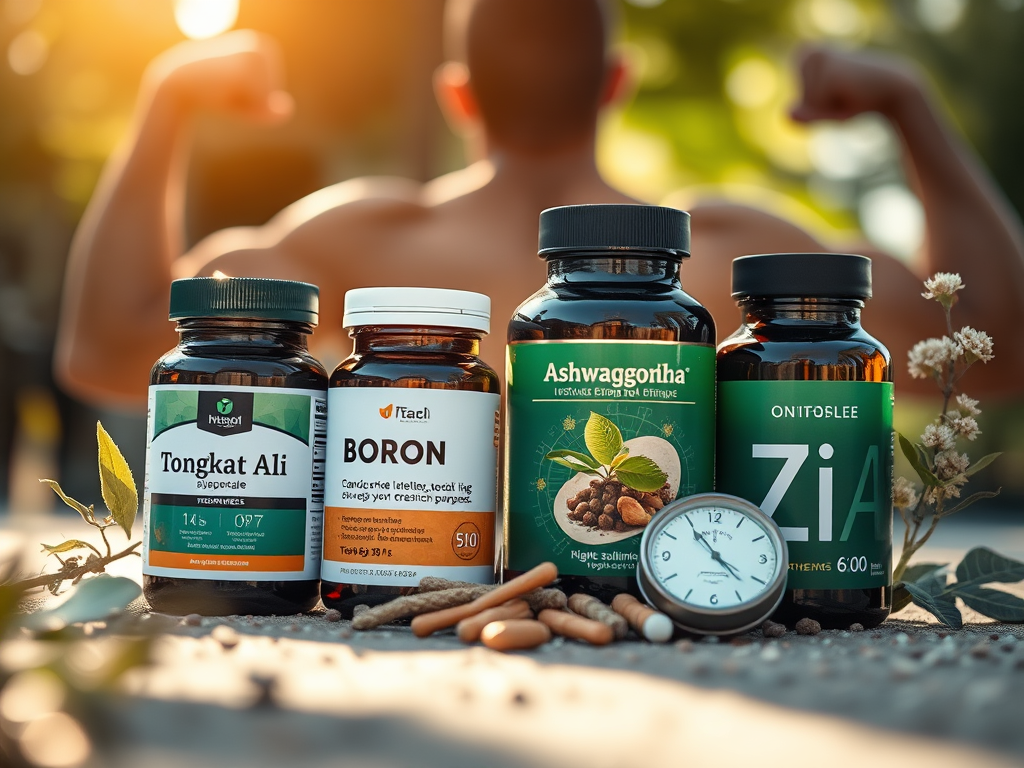
Testosterone optimization in 2026 isn’t about hype, mega-doses, or influencer trends.
It’s about supporting the biological pathways that regulate testosterone production, availability, and signaling.
Below are the supplements with real mechanistic support, explained by what they actually do in the body — not marketing claims.
Tongkat Ali (Eurycoma longifolia)
Key testosterone pathways supported:
- Reduces SHBG (Sex Hormone-Binding Globulin)
Frees up testosterone so more of it is biologically active. - Stimulates Leydig cell activity
Enhances testicular signaling responsible for testosterone synthesis. - Improves cortisol:testosterone ratio
High cortisol suppresses testosterone; Tongkat helps rebalance this. - Enhances androgen receptor responsiveness
Helps testosterone work more effectively at muscle, brain, and libido tissues.
Why it matters:
Many men don’t have low testosterone — they have bound testosterone. Tongkat Ali helps unlock it.
Boron
Key testosterone pathways supported:
- Rapid SHBG reduction
One of the fastest-acting nutrients for increasing free testosterone. - Aromatase modulation
Reduces conversion of testosterone into estrogen. - Increases free testosterone without forcing total T
Improves usability, not just lab numbers. - Reduces inflammatory markers (CRP, TNF-α)
Chronic inflammation directly suppresses androgen signaling.
Why it matters:
Free testosterone drives energy, libido, confidence, and performance — boron directly targets this.
Ashwagandha (Withania somnifera)
Key testosterone pathways supported:
- Lowers cortisol via HPA-axis regulation
Cortisol directly suppresses GnRH → LH → testosterone signaling. - Increases luteinizing hormone (LH)
LH tells the testes to produce testosterone. - Improves testicular health and sperm parameters
Indicates improved androgen production capacity. - Enhances mitochondrial efficiency
Testosterone synthesis is energy-dependent.
Why it matters:
If stress is high, testosterone production will be blunted — no matter how “healthy” you are.
Zinc
Key testosterone pathways supported:
- Required cofactor for steroidogenesis enzymes
Essential for testosterone synthesis. - Reduces aromatase activity
Less testosterone converted into estrogen. - Supports LH and FSH signaling
- Protects androgen receptors from oxidative damage
Why it matters:
Even mild zinc deficiency is strongly associated with low testosterone and reduced androgen signaling.
Vitamin E
Key testosterone pathways supported:
- Antioxidant protection of Leydig cells
Testosterone-producing cells are highly sensitive to oxidative stress. - Improves testicular blood flow
- Preserves steroidogenic enzyme function
- Stabilizes mitochondrial membranes
Why it matters:
Hormones can’t be produced efficiently when oxidative stress damages the cellular machinery.
Vitamin B6 (Pyridoxine / P5P)
Key testosterone pathways supported:
- Reduces prolactin
Elevated prolactin suppresses GnRH and testosterone output. - Supports dopamine synthesis
Dopamine is a key upstream regulator of testosterone. - Enhances androgen receptor signaling
- Improves motivation, drive, and neurological support
Why it matters:
Testosterone is not just a hormone — it’s a neuroendocrine system.
The 2026 Testosterone Reality Check
Increasing testosterone isn’t about forcing levels unnaturally high.
It’s about:
- Increasing free testosterone
- Reducing cortisol and estrogen interference
- Supporting testicular signaling
- Improving androgen receptor sensitivity
This is why smart stacking beats single-ingredient approaches.
If you want a done-for-you approach built around these exact pathways:
- Test Scene → focused Tongkat Ali support for freeing and activating testosterone

- Core Test → boron, zinc, vitamin E, and B6 designed to support androgen production, utilization, and hormonal balance

No extremes. No hormone forcing.
Just pathway-driven testosterone support.


Leave a Reply